Even though humans are omnivorous animals, living in the highly sedentary modern world has led nutritionists to advise that we should make vegetables and fruit dietary staples, as they have much better nutrients to toxins ratio than animal sources.
Due to their ability to resist in a multitude of climates, carrots are cultivated in most areas of the Earth and are an integral part of the everyday diet in a myriad of cultures. Because of their popularity, carrots have also been studied by nutritionists for decades now. Consumption of carrots has benefits that are instilled in modern culture (too many individuals they are automatically linked to the preservation and improvement of eyesight), however, numerous recent and ongoing studies show that the health benefits of carrots are not restricted to the intake of vitamin A and have significant health improvements.
We will explore the whole host of advantages the regular consumption of this versatile vegetable can bring into our lives – from small yet welcomed improvements to digestion and detoxifying properties to significant benefits to the cardiovascular system (carrots help keep cholesterol in check thus leading to a better chance of avoiding heart attacks and strokes) or cancer prevention.
We will also present an exhaustive fact sheet on the nutritional components and values of carrots (both raw and boiled) so that anyone can check if including carrots in one’s diet is a good idea because everyone’s needs are different. As a side note, we will also be discussing a few of the most healthy ways of consuming and cooking carrots in order to get the most out of them.
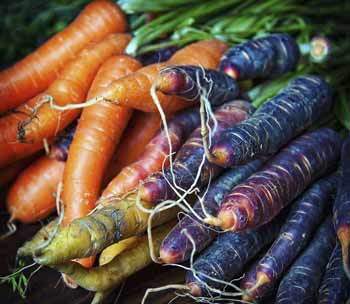
While we are accustomed to the bright orange color of our favorite root vegetable, carrots (which scientifically are known the
sativus subspecies of the
Daucus carota) come in a variety of colors, ranging from black to white, with even some purple varieties. Furthermore, we tend to think of the root as the principle edible part of the plant, yet in ancient times the leaves and seeds were the sought out parts, something consumers mostly discard nowadays.
Carrots have an extensive history as staples of the human diet, with archeological evidence pointing to it being at least 5000 years old. It seems that the plant was domesticated in Central Asia, what is now the territory of Afghanistan, a place which continues to be a haven for the carrot’s wild correspondent. From there, the steady cultivation of carrots spread to Europe (via the Moors in Spain) in the Early Middle Ages and East Asia in the Late Middle Ages via the Silk Road. However, the main variant was the white carrot, with our modern orange carrot being linked with the Dutch trade with the Far East in the 17
th century, which is also the period when the vegetable was introduced to the Americas.
Carrots can take between three to four months to mature and can vary in size from a few inches up to more than five feet. However, selective breeding and modern agricultural developments tend to limit the shape and size of carrots to our familiar images, all the while trying to speed up the process of maturation.
As mentioned in the introductory section, the variety of climates in which the carrot can thrive, coupled with the fact that it can easily be stored over the winter period, makes it one of the most important vegetables worldwide, with more than 37 million tons produced annually. In the US, carrots rank in 9
th place on the most valuable crops list, with carrot consumption rising steadily in the last 25 years.((
https://en.wikipedia.org/wiki/Carrot#Chemistry))
Carrots Nutritional Facts Sheet

The overall caloric makeup of raw carrots is 89% carbohydrates, 5% fats (although this refers to non-saturated fat, carrots having no saturated or trans-unsaturated fatty acids) and the remaining 6% is protein. A serving portion of 128 grams equates to 53 calories, with 3 calories coming from the non-saturated fat. All good news nutrition-wise thus far, the only mild cause for concern is that a significant part of the calories raw carrots provide is derived from sugars. Based on a standard 2000-calorie diet, a single serving of raw carrots contributes to the average healthy person’s 14% of the recommended daily intake of fiber, 4% of recommended sodium, 4% of calcium, 2% of iron intake, a whopping 428% of vitamin A and 13 % of vitamin C.
Furthermore, carrots are an excellent source of
B vitamins – thiamine (vitamin B1), niacin (vitamin B3), vitamin B6, folate – manganese, potassium and vitamin K. What all these statistics mean for the layman is that a daily intake of raw carrots is highly advised for the maintenance of general health and can work wonders in cases of individuals who wish to lose weight, though one should not overly indulge because of the relatively high proportion of sugars. ((
http://nutritiondata.self.com/facts/vegetables-and-vegetable-products/2383/2))
Moving on to the
carbohydrate composition of carrots, a sample of 100 grams of vegetables that have not been freshly harvested (your typical supermarket sample) has 1.1 grams of
glucose, the same amount of
fructose, 5 grams of
sucrose, negligible amounts (less that 0.1 grams) of
maltose and
lactose, 0.1 grams of
starch and 0.3 grams of
oligosaccharides.
The makeup of
fatty acids (considering the same sample of 100 grams of deposited vegetables) is as follows: 0.1 grams of
saturated acids, 0.11 grams of
cis-monounsaturated and 0.08 grams of
cis-polyunsaturated. A schematic explanation of
“saturated vs. unsaturated” fats can be found
here.
100 grams of carrots have the following configuration of
inorganic substances: 178 mg of
potassium, 122 mg of
chloride, 27 mg of
sodium, 26 mg of
calcium, 16 mg of
phosphorus, 7 mg of
magnesium, 0.23 mg of
iron, 0.11 mg of
zinc, 0.07 mg of
manganese, and 0.03 mg of
copper. Carrots also contain traces of rare yet valuable substances such as
iodine (0.7 µg) and
selenium (0.5 µg).
The same amount of carrots has the subsequent make-up of
water soluble vitamins: 2 mg of
vitamin C, 0.27 mg of
pantothenic acid, 0.13 mg of
thiamine, 0.2 mg each of
tryptophan/60 and
niacin, 0.06 mg of
vitamin B6, 0.01 mg of
riboflavin, 8 µg of
folate and 0.3 µg of
biotin.
The real benefits of carrots are evident when we take into account the amounts of
fat soluble vitamins: 5230 µg of
alpha-carotene, 9149 µg of
beta-carotene, 1229 µg of
lutein, 0.09 mg of
vitamin E and 1961 µg of retinol equivalent
vitamin A. The explanation for the last figure is that the human body cannot directly harvest vitamin A from non-animal sources, therefore beta-carotene must pass through a series of chemical processes in order for it to be converted into vitamin A.
Naturally, these figures change dramatically when the vegetables pass through any kind of thermic treatment. As is the case with any type of cooking, some benefits are enhanced while others are diminished. However, we will be exploring this aspect in the section that deals with the healthiest ways of cooking and serving carrots.
The Main Health Benefits of Carrots
Positive Effects on Digestion
The fact that carrots are rich in dietary fiber may have been mentioned only in passing in the preceding section of this article, although that is the main benefit carrots bring to the digestive process. There are two forms of fiber – insoluble and soluble – with carrots exhibiting impressive quantities from both these substances. Fiber may not provide any nutrients to the bloodstream, nevertheless, the average adult needs about 25 grams of dietary fiber each day to keep optimum digestive health. Considering that a single cup of raw carrots contains 3.5 grams of soluble and insoluble fiber combined, we get the aforementioned 14 percent of recommended daily intake.((
http://www.livestrong.com/article/484122-carrots-and-digestion/))
Insoluble fiber is critical in the excretory process, by providing the bulk of the stool and by facilitating the transport of remnants through the colon, thus preventing constipation. Soluble fiber, on the other hand, works much earlier in the digestive process, helping to lower the acidity in the stomach, a fact which slows down the rates at which cholesterol and sugar are absorbed from other foods. This makes for a smooth digestion and also lowers the risk posed by increased cholesterol in heart diseases and elevated blood sugar for type-2 diabetes.
Beta-carotene, the fat soluble vitamin actually named after the carrot, is a chemical precursor of
vitamin A. Presence of this vitamin in the bloodstream favors the production of lymphocytes (or white blood cells), which are responsible for fighting off infections. One of the most vulnerable parts of the human body to infections is the gastrointestinal tract, owing to the fact that potentially infected substances are ingested every day. Keeping that in mind, one should consider that a serving of carrots supplies the body with the raw matter to produce the amount of vitamin A necessary for an adult male.
Aiding the Cardiovascular System
Arteries transport the oxygenated blood to all the tissues of the body and they need all the help they can get from antioxidants derived from digestion in order to maintain an optimum operation. A study performed in the Netherlands over a 10-year period focused on the link between different types of fruit and vegetables and the incidence of cardiovascular disease. The differentiation between the groups of vegetables and fruit was based on color. The study concludes that people who regularly consume orange-colored fruit and vegetables (carrots being chief among them) have the least risk of cardiovascular disease. A further differentiation among those who consume orange vegetables is made when considering the amount consumed – a further 75 grams per day further reduced the risk by almost a quarter.
Although the actual chemical mechanism through which these results are achieved continues to remain a mystery, it seems that the whole complex of antioxidants found in vegetables high in beta-carotene has valuable benefits on the circulatory system. Preliminary data on this subject speculates that polyacetylenes in the carrot composition have anti-aggregatory action in the case of red blood cells, thus explaining the reduction in the incidence of disease. In addition, the properties of carrots in reducing cholesterol levels are well-known by scientists, with gastrointestinal research in Scotland concluding that a 3-week, 7-ounces per day regimen of carrots lowers cholesterol levels by 10 to 15 percent.
Another recent study performed in Italy considered the link between carrot consumption and incidence of heart attacks (myocardial infarction). The study found out that carrots are responsible for the reduction of heart attack rate by nearly two-thirds, though several other variables were also involved.
To round up the potential benefits that carrots have on the cardiovascular system, we should mention the benefits in lowering blood pressure, an aspect that directly influences the incidence of stroke and the rate of survival in case a stroke does occur. Potassium, a mineral that exists in abundance in the carrot root acts as a vasodilator, thus permitting a better flow in the blood vessels. Coumarin is another chemical compound that can be found in carrots, a substance whose properties are only beginning to be understood. Nevertheless, it has proven anti-fungicidal and blood-thinning properties, in addition to its anti-tumoral effects, a subject we will explore a little later. Coming back to the topic of stroke, there are several studies which show that survival rates among stroke patients are best in the cases with higher beta-carotene levels.
Cancer Prevention
As a general observation, beta-carotene reinforces cell membranes through its antioxidant actions, consequently reducing toxic damage while also reducing the pace of cell division in all tissues, including tumorous tissues. A British study concluded that enhancing levels of beta-carotene by 2 mg per day lowered the incidence of lung cancer by almost 40 percent, even in the case of smokers.
In order to get the most out of carrots, at least from an oncological point of view, they should be cooked, preferably boiled whole and chopped after cooking is done. In this form, phytochemicals are released which aid in the fight against oral tumors, cancers of the stomach and esophagus. According to the Journal of Agriculture and Food Chemistry, cooked carrots release a higher concentration of falcarinol, a substance that acts as a natural pesticide and may have beneficial actions against the human papillomavirus (HPV), which is responsible for cervical cancer.((
https://www.ncbi.nlm.nih.gov/pubmed/26819805))
Improved Eyesight

We have finally arrived at this “traditional” benefit of carrot consumption because it simply is one of the most insignificant. This is where the power of the popular myth can be seen in all its splendor. That is not to say that carrots are wholly without merit when it comes to eyesight, however, their role has really been blown out of proportion.
Eating carrots regularly will not provide any structural benefits, yet a severe deficiency in vitamin A causes serious conditions like macular degeneration (an acceleration in the natural degradation of vision, a condition which can lead to blindness and actually is the chief cause of blindness in underdeveloped countries), cataracts and xerophthalmia (an endocrinological disorder in which the eyes are unable to generate tears).
Another argument in favor of carrot consumption in the ophthalmological area is the benefits of lutein, an antioxidant contained in carrots which strengthen the tissues around the retina, thus providing more protection, which is welcomed, especially with age. With that said, carrots are not wondrous vegetables that provide 360-degree vision.
Cooking Carrots in a Healthy Way
As we have already pointed out, you get more nutrients out of carrots when they are cooked, as opposed to eating them raw. However, there are a few caveats in this acknowledgment.
First of all, the best way of cooking that maximizes the nutritional value of carrots is through boiling, or more precisely, rapidly bringing them to the boiling point and only boiling until they become tender enough to consume. This manner of cooking increases the number of nutrients (particularly lutein) by approximately 15 percent, in comparison to raw carrots.
However, taste-wise, naturally that cannot be satisfactory to the gourmand in every one of us. Steaming seems to be the next best thing apart from boiling, as it makes the vegetables lose only an insignificant portion of nutrients. There is a method name
Healthy Steaming, which advocates that the problem is not with the steaming per sé, but with finding a way of reducing the amount of time the vegetables are exposed to the heat, the degree and nature of the heat and the manner in which the carrots interact with the cooking oils (the less used, the better). While not exhibiting the same healthy results as boiling, many people found that
Healthy Steaming garnered the best flavor out of carrots. It involves a steamer, 2 inches of water brought rapidly to the boiling point and a no more than 5-minute steam.
Sautéing carrots definitely goes against eating for nutritional value, although no more than 30 percent of nutritional value is wasted in this manner. The key to preserving it lies more in the level of temperature used rather than the cooking time, with the minimum feasible temperature being the recommended way to go. Also, remember to cook carrots whole and peel or slice them afterward.
Reviewing the nutritional facts sheet and browsing through the many health benefits that carrots can bring to everyone’s diet makes one wonder why it is not further up the list of world’s dietary staples, considering its affordability. Furthermore, it is a highly versatile actor in the kitchen. And while certain properties have been blown out of proportion across the years by popular culture, the list of advantages one stands to gain from the regular consumption of carrots really is impressive. Nevertheless, healthy eating does take a bit of effort, with the first endeavor being becoming and staying informed before throwing some vegetables into the pan.
https://www.youtube.com/watch?v=Yv33MxZZz3c