CLA Safflower Oil: Benefits, Risks, and Realistic Results
CLA Safflower Oil: The Evidence-Based Ultimate Guide for Benefits, Risks, and Realistic Results

Reviewed by Healthy Living Benefits Medical Review Team, MD
CLA safflower oil has been marketed as a shortcut for fat loss, lean muscle support, and metabolic improvement. The sales pitch is simple: take a capsule, target stubborn body fat, and improve body composition with minimal effort. Real physiology is more complicated than that. Conjugated linoleic acid (CLA) is a group of fatty-acid isomers, and safflower oil is a rich source of linoleic acid, but the metabolic effects depend on formulation, dose, duration, baseline health, and lifestyle context.
This guide separates what current evidence supports from what marketing often exaggerates. You will learn what CLA safflower oil is, where evidence is strongest and weakest, what side effects matter, and how to evaluate whether this supplement belongs in your plan at all. You will also see where food-first strategies, sleep quality, and training consistency often produce larger long-term results than any single supplement.
TL;DR: CLA safflower oil may produce small body-composition changes in some adults, but it is not a stand-alone fat-loss solution. Benefits are usually modest, side effects are possible, and the best outcomes still come from diet quality, movement, and sleep consistency.
Why has CLA safflower oil stayed popular despite mixed research results?
It remains popular because it sits at the intersection of two powerful consumer goals: weight control and metabolic health. People want options that feel practical, non-prescription, and easy to add to a daily routine. A capsule appears easier than redesigning meals, improving sleep timing, and sustaining exercise habits for months.
Some studies do report reductions in fat mass or modest improvements in body composition with CLA supplementation, including early and later pooled analyses (Gaullier et al., American Journal of Clinical Nutrition, 2007; Onakpoya et al., Clinical Nutrition, 2018). At the same time, other trials and subgroup analyses show small effects or limited clinical relevance. This creates a common pattern: enough positive data to keep interest high, enough inconsistency to prevent strong universal conclusions.
Another reason is message framing. Marketing headlines often treat any statistically significant shift as a transformative outcome. In clinical terms, a measurable effect does not automatically mean a large or visible real-world change for every person. That distinction is crucial when deciding whether to spend money and assume potential side effects.
For context on broader fat-loss fundamentals, the site’s weight-loss primer at how to lose weight fast explains why energy balance, adherence, and behavior design still dominate outcomes over time.
What exactly is CLA safflower oil, and how is it different from regular safflower oil?

CLA stands for conjugated linoleic acid, a family of linoleic-acid isomers. These isomers are naturally present in small amounts in ruminant foods such as dairy and beef. Supplement products labeled “CLA safflower oil” are typically produced by modifying safflower oil to enrich specific CLA isomers, usually c9,t11 and t10,c12 in varying ratios depending on manufacturer processing.
Regular safflower oil sold for cooking is largely linoleic acid (or, in high-oleic versions, mostly oleic acid), but it is not identical to supplemental CLA concentrates. That difference matters. You cannot assume that health effects of cooking oils transfer directly to high-dose CLA supplements, or vice versa.
From a metabolism perspective, proposed mechanisms include effects on lipid oxidation, adipocyte biology, inflammation signaling, and insulin-related pathways. Mechanistic plausibility exists, but mechanisms alone are not enough to confirm clinically meaningful long-term outcomes in diverse human populations.
When comparing fats more generally, it helps to review broader dietary-fat guidance and cardiovascular context, including resources like omega-3 benefits and sources, then evaluate where CLA products fit in that bigger picture.
How much fat loss can most people realistically expect from CLA supplements?
The honest answer is: often small, sometimes negligible, and very rarely dramatic without concurrent lifestyle changes. Across human studies and pooled analyses, average effects on body fat are usually modest relative to what people expect from supplement advertising.
In a frequently cited meta-analysis, the estimated fat-mass effect size was modest, with change magnitude that is measurable but not dramatic in daily life (AJCN, 2007). Later meta-analyses in overweight/obese populations also found small average improvements in weight, BMI, and fat mass rather than transformative outcomes (Clinical Nutrition, 2018). Individual responses still vary by baseline adiposity, habitual diet, dose used, and supplementation duration.
If a person is in a consistent calorie surplus, sleeping poorly, and mostly sedentary, CLA is unlikely to overcome those factors. If someone already has a structured nutrition plan, progressive exercise routine, and good adherence, a small adjunctive benefit is more plausible, though still not guaranteed.
| Expectation | What evidence usually supports | Practical takeaway |
|---|---|---|
| Rapid visible fat loss from capsules alone | Not consistently supported in controlled trials | Do not rely on supplement-only strategy |
| Small body-fat improvement over months | Possible in some cohorts, effect often modest | Set conservative goals and track objectively |
| Muscle gain without resistance training | Weak support | Training stimulus is non-negotiable for lean mass |
| Universal response across all users | Not realistic; high variability between individuals | Use trial-and-measure approach, not assumptions |
To improve expectation-setting, compare supplement effects with core interventions such as exercise progression and meal-structure consistency. Those lifestyle changes typically provide larger, more dependable returns per unit of effort.
A key statistic: body-composition effects are often measurable but not dramatic
One reason confusion persists is the gap between statistical significance and meaningful day-to-day outcomes. A supplement can produce a measurable shift in pooled data while still delivering a change too small for many users to notice quickly in mirror, clothes fit, or performance. This is exactly the pattern reported in multiple CLA syntheses: statistically significant but modest anthropometric effects (AJCN, 2007; Clinical Nutrition, 2018).
You should interpret CLA evidence through three filters:
- Absolute effect size rather than headline claim.
- Duration needed to achieve that effect.
- Tradeoffs in tolerability and metabolic markers.
For example, if an intervention produces modest fat-mass reduction but worsens gastrointestinal comfort or causes adherence problems, real-world utility drops. If the same result can be matched or exceeded by small dietary and activity changes, the supplement may be unnecessary for many people.
A useful mental model is “marginal gain, marginal risk.” That does not make CLA inherently good or bad; it means the decision should be personalized and data-driven rather than hype-driven.
Could CLA safflower oil improve metabolic markers like insulin sensitivity or lipids?
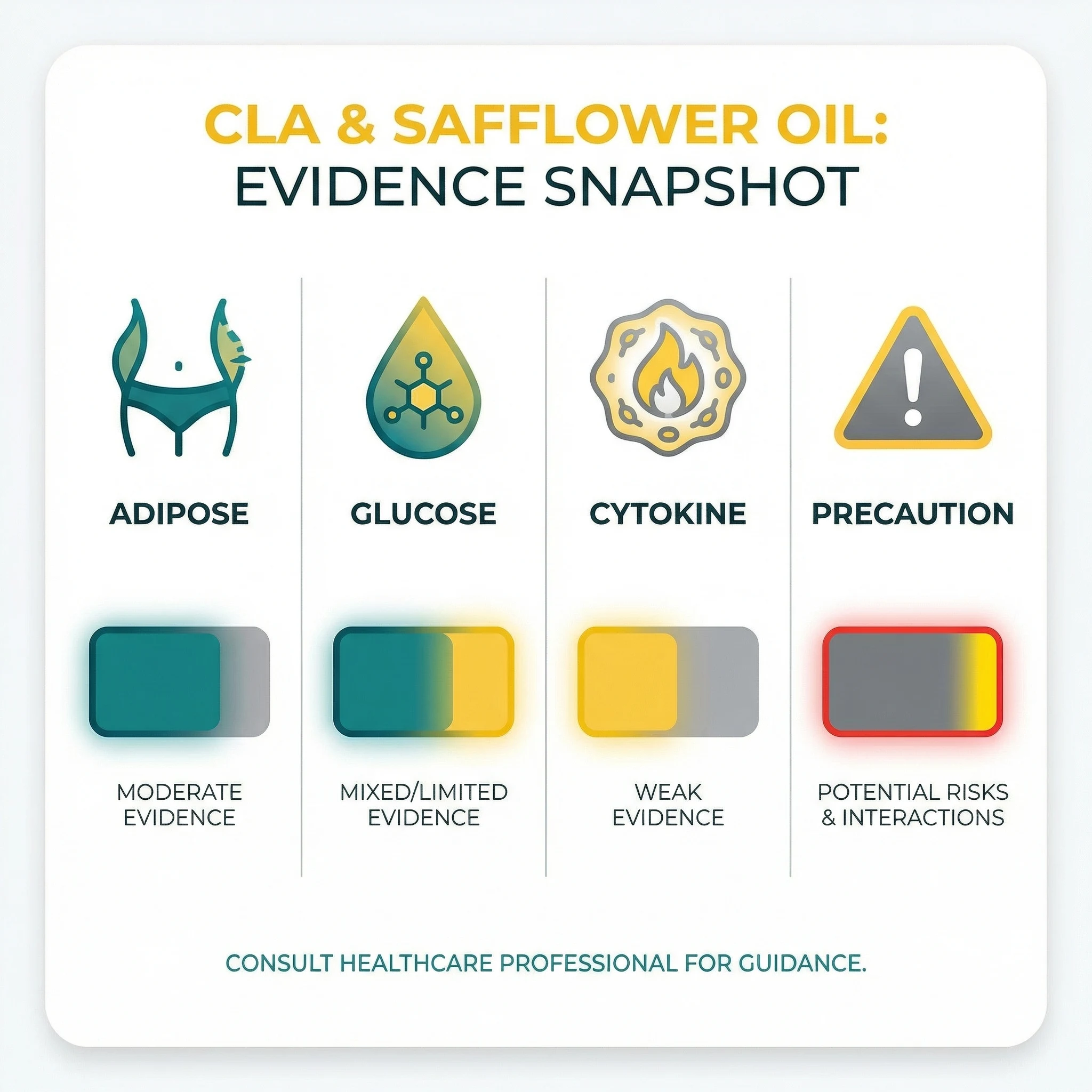
This is where caution is essential. Some mechanistic and clinical work suggests potential metabolic effects, but findings across studies are mixed. In certain populations or formulations, concerns have been raised about insulin sensitivity, inflammatory markers, or lipid changes, especially with long-term high-dose use of specific isomer distributions (Riserus et al., Diabetes Care, 2004; Ghodoosi et al., Nutrition Journal, 2023).
Evidence is also formulation-specific. In a randomized crossover trial in obese postmenopausal women with type 2 diabetes, CLA and safflower oil showed different patterns across body-composition and metabolic outcomes, reinforcing that not all fatty-acid supplements can be treated as interchangeable (Norris et al., American Journal of Clinical Nutrition, 2009).
Not every study shows harm, and not every product behaves identically. However, uncertainty in this domain means high-risk groups should not self-prescribe based on marketing language alone. People with diabetes, prediabetes, dyslipidemia, fatty liver disease, or cardiovascular risk factors should involve a clinician before initiating CLA supplementation.
If metabolic health is your main target, first-line strategies still include dietary quality, physical activity, sleep, and evidence-based medical care where appropriate. The article approved diets that prevent or help with diabetes is a better starting framework for many readers than supplement-first plans.
| Metabolic goal | Supplement-only expectation | Higher-yield foundation |
|---|---|---|
| Improve insulin control | Uncertain and variable with CLA | Carbohydrate quality, activity timing, sleep regularity |
| Improve lipid profile | Mixed evidence; product dependent | Fiber intake, fat quality, medical follow-up |
| Reduce inflammation load | Inconsistent direct effect | Weight management, movement, whole-food pattern |
| Sustainable body composition change | Usually modest adjunct at best | Adherence to nutrition + resistance training |
What side effects and warnings deserve the most attention before trying CLA?

Many users tolerate CLA reasonably well, but “natural supplement” does not mean side-effect free. Reported issues include digestive discomfort, nausea, loose stools, bloating, and occasional fatigue. In metabolic-risk cohorts, researchers have also monitored shifts in glucose handling, liver enzymes, and inflammatory markers (Nutrition Journal, 2023; Diabetes Care, 2004).
Common high-priority warnings include:
- Use caution in diabetes, prediabetes, or insulin-resistance states.
- Use caution with liver disease or unexplained liver enzyme elevation.
- Use caution if taking multiple supplements with overlapping metabolic effects.
- Avoid in pregnancy and breastfeeding unless explicitly cleared by a licensed clinician.
- Discontinue and seek care if meaningful adverse symptoms occur.
Supplement quality is another issue. In the U.S., dietary supplements are generally not pre-approved by the FDA for safety and effectiveness before marketing (FDA consumer guidance). Third-party testing certifications and transparent labeling reduce risk but do not eliminate it.
If you are already using weight-loss products, check overlap carefully. The site’s overview on best weight loss supplements can help you identify redundant stacking patterns and safety pitfalls.
Myth vs fact: what CLA safflower oil can and cannot do
| Myth | Fact | What to do instead |
|---|---|---|
| CLA melts fat without any diet change. | Evidence suggests at most modest effects, usually as an adjunct. | Prioritize energy balance and meal adherence first. |
| More capsules always mean faster results. | Higher doses can increase side effects without proportional benefit. | Use conservative dosing and monitor tolerance. |
| All safflower oils work the same way. | Cooking safflower oil and CLA-enriched supplements are different products. | Read labels for isomer blend and dose clarity. |
| If it is sold online, safety is fully established. | Supplement regulation and quality vary; premarket proof is limited. | Choose third-party tested products and involve clinicians when high risk. |
| CLA replaces exercise for body composition. | Training remains the main driver of lean-mass retention and fat loss. | Combine nutrition, resistance work, and sleep with any supplement trial. |
This comparison table is important because many users abandon high-yield habits while chasing low-yield shortcuts. If you protect habits first, any supplement decision becomes more rational and safer.
How should you dose and trial CLA safflower oil if you still want to test it?
Dosing used in studies varies, and product concentration can differ by brand, so label interpretation is critical. Most users should avoid aggressive “front-loading” approaches and instead use a conservative, structured trial with predefined success metrics.
A practical framework:
- Define one primary goal (for example, waist reduction, body-fat percentage trend, or satiety support).
- Track a 1- to 2-week baseline with no new supplements.
- Introduce CLA alone, not as part of a complex new stack.
- Hold diet, sleep schedule, and training plan as stable as possible.
- Reassess at 8 to 12 weeks using objective metrics and tolerance notes.
Stop early if side effects are meaningful, if lab markers worsen, or if no measurable benefit appears despite consistent adherence.
| Trial phase | What to track | Decision trigger |
|---|---|---|
| Baseline (weeks 0-2) | Weight trend, waist, sleep, GI comfort, training consistency | No decision yet; establish control data |
| Intervention (weeks 3-8) | Same metrics + dose/timing adherence | Continue only if tolerable and objective trend improves |
| Reevaluation (weeks 9-12) | Body composition trend and side-effect burden | Stop if benefit is absent or minimal |
Which lifestyle changes usually outperform CLA for long-term fat loss?

For most people, the biggest return still comes from fundamentals:
- A sustainable calorie target rather than extreme short-term restriction.
- Higher protein intake to preserve lean mass during fat loss.
- Resistance training 2 to 4 times per week.
- Daily movement targets (walking, light activity, reduced sedentary time).
- Consistent sleep timing and duration.
These interventions are not flashy, but they are robust. They also improve broader health markers and quality of life beyond scale weight. In contrast, supplement-only strategies are vulnerable to discontinuation and disappointment because they do not address behavior architecture.
If exercise programming is your weak link, resources like how to lose weight with yoga can be a useful entry point for people who need a lower-friction movement routine.
Quick reality check: If sleep, protein intake, and weekly movement are unstable, fixing those first is usually more powerful than adding or switching supplements.
Who should probably avoid CLA safflower oil unless a clinician says otherwise?
While decisions should be individualized, higher-caution groups generally include:
- People with diabetes or prediabetes who are not under active clinical monitoring.
- People with known liver disease or prior unexplained liver-enzyme elevations.
- People taking multiple medications where interaction risk is unclear.
- Pregnant or breastfeeding individuals.
- People with history of intolerance to fatty-acid supplements.
For these groups, the risk of unintended effects may outweigh uncertain fat-loss benefits. A clinician can help determine whether testing is reasonable, whether lab monitoring is appropriate, and whether safer alternatives exist.
Remember that supplement quality, dosing accuracy, and product purity can vary. The safest path is not just choosing a popular brand; it is choosing a strategy that matches your health profile and includes monitoring.
What should you look for on a CLA product label before buying?
Not all products are equally transparent. Before purchase, check:
- Total CLA per serving, not just total oil amount.
- Isomer blend disclosure (if available).
- Third-party testing/certification information.
- Clear allergen and excipient list.
- No exaggerated disease-treatment claims.
If labels are vague, skip the product. If claims promise dramatic fat loss in days, skip it. Reliable products usually emphasize measured outcomes, appropriate use, and safety notes, not miracle language.
Budget also matters. If the same monthly spend could fund higher-quality groceries, a gym plan, or coaching support that improves adherence, those options may produce far better ROI than a supplement trial.
How do you know whether CLA is helping you or just adding cost?
Measure outcomes you can trust:
- Weekly average body weight, not isolated daily fluctuations.
- Waist circumference under standardized conditions.
- Training performance trends and recovery quality.
- Appetite consistency and snack control.
- Any new GI symptoms, fatigue, or sleep disturbance.
A useful rule is the “12-week evidence rule.” If after roughly 12 weeks there is no clear objective improvement beyond your baseline trend, continuing is difficult to justify. If adverse symptoms appear, discontinuation and clinician review are prudent.
Supplements should earn their place in your routine. If they do not show measurable value, you are usually better served reallocating effort and budget to fundamentals that reliably improve body composition and health.
Frequently asked questions about CLA safflower oil
Is CLA safflower oil the same as cooking with safflower oil?
No. CLA supplements are concentrated products designed to provide specific CLA isomers, while cooking safflower oil is primarily a culinary fat source with a different fatty-acid profile and dose context.
How long does it take to see results with CLA?
If benefits occur, they usually appear gradually over weeks to months, not days. Most meaningful evaluations require at least 8 to 12 weeks with stable diet and activity patterns.
Can CLA safflower oil build muscle by itself?
Not reliably. Lean-mass gains require training stimulus and adequate protein intake. CLA is not a substitute for resistance exercise or progressive overload.
Can I combine CLA with other fat-loss supplements?
Combination use can increase side-effect and confounding risk. If you test CLA, start with CLA alone so you can evaluate tolerability and effectiveness clearly.
Should people with blood sugar concerns use CLA without medical advice?
No. Because metabolic responses may vary and some studies have raised caution for insulin-related outcomes in certain contexts, clinician oversight is recommended for anyone with blood sugar risk factors.
The bottom line: CLA safflower oil is an optional adjunct, not a primary strategy
CLA safflower oil is best viewed as a possible adjunct for selected adults who already have strong foundations and who can monitor outcomes carefully. It is not a replacement for nutrition quality, resistance training, sleep, and long-term habit consistency.
If your fundamentals are currently inconsistent, fix those first. If they are strong and you still want to test CLA, do it conservatively, track objective metrics, and stop if benefit is absent or side effects emerge. That evidence-first approach protects both your health and your decision quality.
The most effective fat-loss plan is usually the one you can sustain for months, not the one with the most aggressive promise on the label.