How to Shed Pounds and Keep Them Off
How to Shed Pounds and Keep Them Off: The Evidence-Based Ultimate Guide

Most people do not struggle to lose weight for two weeks. They struggle to keep progress for two years. That distinction matters because the physiology of initial loss and long-term maintenance are not identical. Early success can come from motivation and rapid behavior change. Lasting success requires systems that still work when life gets busy, sleep gets inconsistent, stress rises, and motivation falls.
Reviewed by Healthy Living Benefits Medical Review Team, MD
This guide is built for long-term results, not quick-fix promises. You will learn what the best evidence says about nutrition quality, protein and fiber targets, activity minimums, sleep and stress effects, and behavior design that reduces regain risk. You will also get a practical 12-week roadmap and decision tools you can actually use in normal life. If your goals include blood-sugar stability, this framework pairs well with our guide on diets that help prevent or manage diabetes.
Quick take: Sustainable weight loss usually comes from a repeatable routine of high-satiety meals, regular movement, sleep protection, and weekly course-correction, not from extreme restriction.
Can you lose weight without feeling like you're always dieting?
Yes. In fact, that is the point. If your plan feels unbearable after ten days, it is unlikely to survive ten months. Sustainable fat loss depends on creating a modest, repeatable energy deficit while protecting satiety, muscle mass, and day-to-day function. Very aggressive plans can produce rapid scale changes, but they often increase hunger, fatigue, social friction, and rebound eating risk.
A better model is to focus on dietary structure before calorie precision. Build meals around lean protein, high-fiber carbohydrates, vegetables, and minimally processed fats. This approach tends to lower spontaneous calorie intake without forcing constant mental math. In controlled feeding research, dietary pattern and food processing level strongly influence energy intake and satiety. A notable crossover trial found participants ate substantially more calories on ultra-processed diets than on minimally processed diets when meals were matched for presented macros and offered ad libitum (Hall et al., Cell Metabolism, 2019).
This does not mean every packaged food is harmful or that all weight loss requires perfect cooking at home. It means calorie control gets easier when your default foods are harder to overeat. If your grocery baseline is mostly high-fiber staples, proteins, fruit, and vegetables, your appetite curve usually improves before you ever open a tracking app.
A 5% to 10% weight loss can improve blood pressure, glucose, and triglycerides
Many people underestimate what counts as clinically meaningful progress. They assume health benefits appear only after very large losses. Evidence says otherwise. Across major guideline statements, losing around 5% to 10% of initial body weight is associated with measurable improvements in cardiometabolic markers, including blood pressure, triglycerides, and glycemic metrics in higher-risk groups (AHA/ACC/TOS guideline updates; Endocrine Society guidance).
That is a strategic advantage. You do not need to wait for a dramatic transformation to experience meaningful health wins. If your starting weight is 220 pounds, a 5% reduction is 11 pounds. That can already move risk markers in the right direction. Framing progress this way reduces all-or-nothing thinking and helps people stay consistent longer.
| Weight-loss range | What often improves | Why this helps adherence |
|---|---|---|
| 3% to 5% | Early shifts in fasting glucose, blood pressure, and mobility comfort | Fast feedback increases confidence and routine consistency |
| 5% to 10% | Stronger cardiometabolic improvement in many adults | Health gains arrive before extreme body-composition change |
| 10% to 15% | Larger risk-factor shifts and functional benefits in many patients | Maintenance planning becomes the main priority |
If your target includes more stable post-meal energy, compare meal choices with the practical principles in our article on low and high glycemic index foods.
The week your motivation dips is usually when systems matter more than willpower
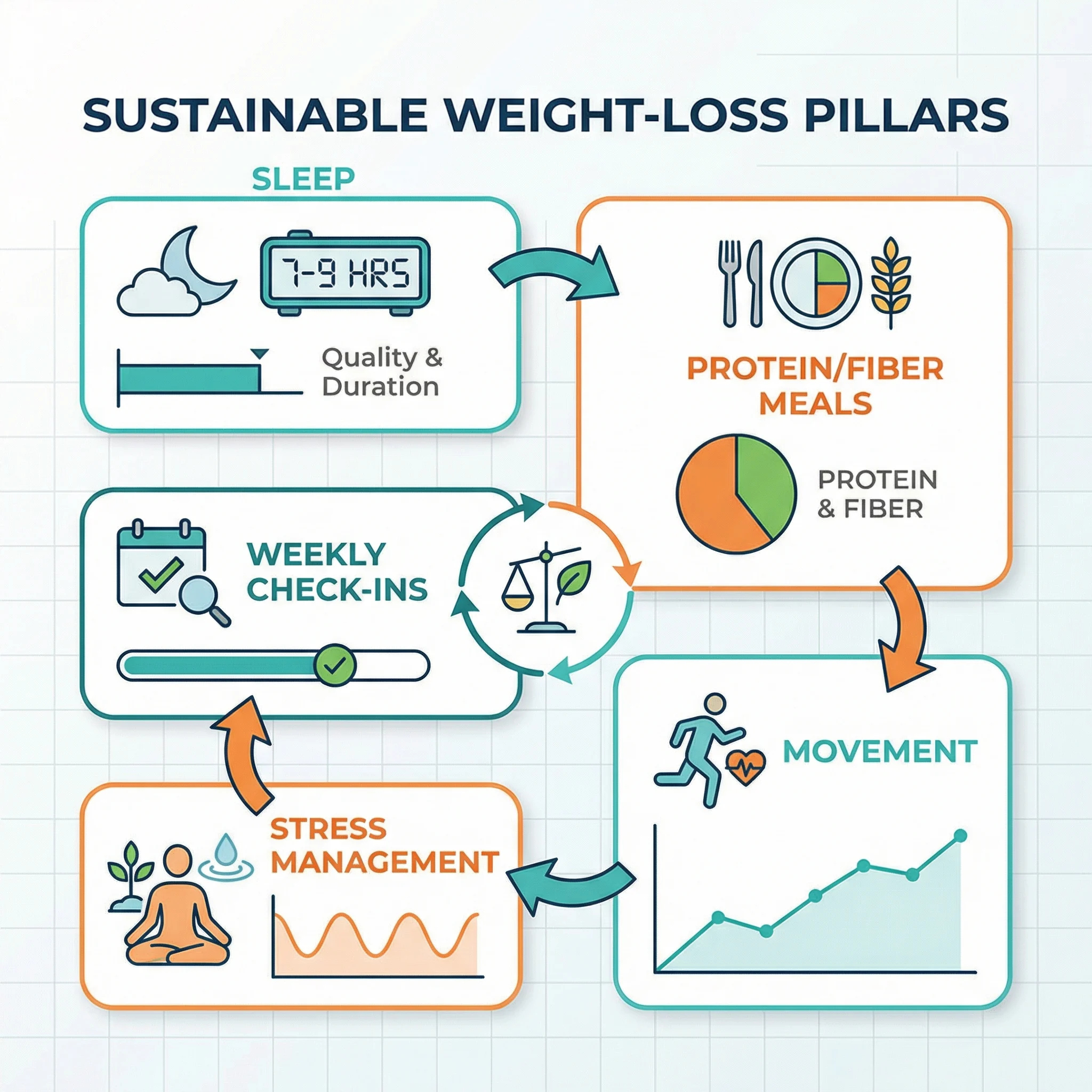
Willpower is useful, but unreliable as a primary strategy. Systems are what carry you when motivation drops. A weight-loss system is a small set of defaults you can run on low energy: repeat breakfasts, a pre-planned grocery list, a minimum movement target, evening wind-down rules, and a weekly review with one to two corrective actions.
The most successful long-term maintainers tend to rely on repeatable behaviors rather than constant novelty. Data from long-running registries of weight-loss maintainers consistently highlight behaviors such as frequent self-weighing, regular physical activity, consistent meal patterns, and quick response to small regain episodes (National Weight Control Registry reports).
Think of this as operational design. Your environment should make the next good choice easier than the next impulsive one. Keep protein-forward foods visible. Pre-portion snacks. Decide tomorrow's first meal before you sleep. Put walking shoes near the door. Keep highly palatable trigger foods in inconvenient locations, not eye level. Tiny friction changes are often more powerful than motivational speeches.

If your shopping routine still feels chaotic, start with a simple food-quality anchor from our guide to choosing whole foods.
"Eat less, move more" is incomplete advice for real life
The phrase is not wrong, but it is too vague to implement under real constraints. People need actionable decisions, not slogans. "Eat less" becomes practical only when translated into meal composition, portion architecture, and satiety strategy. "Move more" becomes practical only when translated into specific weekly minutes, strength sessions, and daily step baselines.
For nutrition, satiety is the central lever. Meals rich in protein and fiber improve fullness and reduce later overeating risk. A higher-protein pattern is repeatedly associated with better retention of lean mass during weight loss and improved satiety response in many controlled trials and meta-analyses. Fiber helps by increasing meal volume and slowing gastric emptying, while also improving dietary quality.
For activity, training protects metabolic health and helps preserve muscle during calorie deficits. Aerobic work supports energy expenditure and cardiometabolic outcomes. Resistance training protects strength and lean tissue, which matters for function and long-term maintenance. You do not need elite volumes, but you do need consistency.
For behavior, your plan should include explicit fallback options. Busy week. Poor sleep. Travel. Family event. Each of these needs a pre-written "minimum effective" plan so one rough day does not become two rough weeks.
Why weight regain happens even when you did everything right at first
Regain is common and not a personal failure narrative. Biology and behavior both contribute. After weight loss, resting energy expenditure can decrease somewhat, appetite signals can rise, and food reward salience may increase in some individuals. That creates a tighter margin for maintenance than many people expect. You may need slightly more structure after weight loss than before it.
The Diabetes Prevention Program and its follow-up work are useful here. Lifestyle intervention can substantially reduce progression to type 2 diabetes in high-risk adults, but the best results come from sustained behavior change and long-term follow-up, not one short intervention phase (DPP Research Group, NEJM 2002; longitudinal follow-up reports).
Psychology also matters. Early success can create overconfidence, then routine drift starts quietly. Portion sizes creep up. Weigh-ins become less frequent. Weekend intake expands. Sleep narrows. None of these changes feels dramatic alone, but combined they erase the deficit. The fix is not panic. The fix is early detection and quick correction.
| Common regain driver | Early warning sign | Fast corrective action |
|---|---|---|
| Portion creep | Calories feel unchanged but weight trends up | Re-plate meals in bowls or smaller plates for two weeks |
| Protein drop-off | Hunger rises late afternoon and evening | Add structured protein at breakfast and lunch |
| Lower activity | Step count and training frequency decline | Set a non-negotiable weekly movement floor |
| Sleep debt | Cravings and snacking frequency increase | Protect fixed bedtime and reduce late caffeine |
The plate formula that makes calorie control easier without counting every bite
You can run a high-quality deficit with a visual plate method. For most main meals, start with one-half non-starchy vegetables, one-quarter lean protein, and one-quarter high-fiber carbohydrates or legumes. Add healthy fats in measured amounts rather than free-pouring. This framework improves nutrient density and helps appetite control while keeping decisions simple.

Protein targets vary by body size, age, and training status, but many adults pursuing fat loss do well with protein distributed across meals instead of concentrated at dinner. Fiber targets should be approached gradually to avoid GI discomfort, with hydration increasing in parallel.
| Meal component | Practical target | Examples |
|---|---|---|
| Protein anchor | Present at every main meal | Eggs, yogurt, fish, tofu, chicken, legumes |
| Vegetable volume | Fill roughly half the plate | Leafy greens, broccoli, peppers, cucumbers, zucchini |
| Smart carbohydrate | Fiber-forward and portioned | Beans, oats, brown rice, potatoes, fruit |
| Fats | Measured, not accidental | Olive oil, nuts, seeds, avocado |
If cravings are your main challenge, combine this structure with behavioral options in our article on natural appetite suppressants.
Myth vs fact: the beliefs that quietly sabotage long-term fat loss
| Myth | Fact | What to do instead |
|---|---|---|
| You must feel hungry all day to lose fat. | Persistent severe hunger usually predicts poor adherence and rebound risk. | Increase protein, fiber, and food volume before cutting more calories. |
| Carbs at night automatically cause fat gain. | Total intake, food quality, and routine consistency matter more than clock time alone. | Use portioned, fiber-rich carbs where they support adherence and training. |
| Cardio alone is enough for long-term maintenance. | Resistance training helps preserve lean mass and functional capacity. | Combine aerobic work with 2 to 3 weekly strength sessions. |
| If weight plateaus for a week, the plan failed. | Short plateaus are common due to fluid shifts, stress, and cycle-related changes. | Review 2 to 4 week trends before making large changes. |
| One off-plan meal ruins progress. | Single events matter less than what you do the next day. | Return immediately to your baseline routine without compensation extremes. |
What should your weekly exercise minimum look like if fat loss is the goal?
A practical minimum for many adults is built around three layers: regular steps, planned aerobic sessions, and resistance training. Public-health guidelines support at least 150 minutes of moderate-intensity aerobic activity weekly plus muscle-strengthening work on two or more days. For weight-loss maintenance, some individuals need higher volumes, but starting with a consistent floor is better than inconsistent extremes.

| Training layer | Minimum starting target | Why it matters |
|---|---|---|
| Daily movement | Consistent step baseline tailored to current level | Supports total energy expenditure and glucose control |
| Aerobic training | About 150 minutes weekly moderate intensity | Cardiometabolic and endurance benefits |
| Strength training | 2 to 3 sessions weekly covering major muscle groups | Lean-mass retention and functional capacity |
Progression should be gradual. If you are new to training, start with shorter sessions and increase total weekly volume over four to six weeks. Injury risk from sudden spikes can derail momentum faster than a conservative start.
How sleep, stress, and appetite hormones push your plan off track
Sleep and stress are not secondary topics. They are appetite and adherence variables. Short sleep is associated with higher hunger, more reward-driven eating, and reduced diet quality in many observational and experimental settings. Stress can increase preference for energy-dense foods and reduce planning quality. Together, they create the exact conditions that make overeating more likely.
You do not need a perfect biohacking routine to benefit. Start with a fixed wake time, a realistic bedtime window, and a wind-down sequence that limits late bright light and stimulating media. Keep late caffeine in check. Protect a short pre-sleep routine even during busy weeks. These steps improve next-day appetite control more than most people expect.
For a simple implementation checklist, use our practical sleep guide on improving sleep habits.
Reality check: If your sleep drops to five to six hours and stress is high, your appetite system is not "weak." It is responding predictably to biological pressure.
Stress management can stay simple. Ten-minute walks after meals, brief breathing resets, planned pause points during work, and predictable meal timing all reduce decision fatigue. You are not trying to eliminate stress entirely. You are trying to prevent stress from dictating food decisions all day.
A 12-week roadmap that turns short-term effort into long-term maintenance
Most plans fail because they have no transition strategy. They start with high intensity and no maintenance architecture. A better approach is phased implementation: foundation, consolidation, and maintenance rehearsal.
| Phase | Primary goal | Key actions |
|---|---|---|
| Weeks 1 to 4 | Stabilize routine and food quality | Standardize breakfast and lunch, set step floor, add two strength sessions |
| Weeks 5 to 8 | Refine deficit and improve consistency | Tighten portions, increase protein distribution, protect sleep window |
| Weeks 9 to 12 | Practice maintenance behaviors before goal is reached | Add planned flexibility meals, maintain weigh-ins, rehearse travel and social-event strategy |
During all phases, track trends instead of daily emotion. A practical weekly dashboard includes body-weight trend, waist measurement, average steps, training sessions completed, sleep consistency score, and one behavior focus for the upcoming week. Keep it simple enough to run in five minutes.
If weight loss stalls for more than three to four weeks despite high adherence, adjust one variable at a time. Common options include modest portion reductions, increased daily movement, or tighter weekend structure. Avoid stacking many changes simultaneously, because you will not know what worked.
When you approach your target range, shift attention from "faster loss" to "stable maintenance." This is where many people disengage too early. Keep the routines that created progress, then increase flexibility slowly while monitoring trends.
Frequently Asked Questions About Losing Weight and Keeping It Off
What is a realistic weekly weight-loss pace?
For many adults, a slower pace is more sustainable and better for adherence. Rapid early loss can occur, especially when diet quality improves quickly, but long-term success usually depends on preserving routine quality and minimizing rebound risk.
Should I count calories forever?
Not necessarily. Some people benefit from temporary tracking to calibrate portions, then transition to structured meal templates and weekly trend monitoring. Others prefer ongoing light tracking. The right approach is the one you can sustain without burnout.
Do I need to remove all favorite foods?
No. Total restriction often backfires. Planned flexibility usually works better than rigid elimination. The key is context, portioning, and frequency, not moral labels like "good" or "bad" food.
What if I regain a few pounds after initial success?
Small regain episodes are common. Respond early with simple corrections: restore weigh-ins, tighten portions for one to two weeks, increase steps, and review sleep. Fast course-correction is usually more effective than extreme compensation.
When should I ask for medical support?
If you have obesity-related conditions, repeated regain cycles, medication-related weight changes, or signs of disordered eating, professional guidance is appropriate. Physician and registered-dietitian support can improve both safety and outcomes.
The bottom line: consistency beats intensity every time
Sustainable fat loss is not built on perfect days. It is built on repeatable average days that keep moving in the right direction. High-satiety meals, activity minimums, sleep protection, and weekly review loops are the durable core. Everything else is optional detail.
If you want one starting move this week, make it this: set your next seven days before they begin. Choose repeat meals, schedule movement, define bedtime boundaries, and decide how you will handle two predictable friction points. When the week starts, execute the plan you already wrote. That is how pounds come off and stay off.
Long-term success looks less dramatic than quick-fix marketing, but it is more powerful. You are not chasing a short sprint. You are building a body-weight pattern you can keep for years.