Nootropics for the Mental Edge: The Evidence-Based Ultimate Guide
Nootropics for the Mental Edge: The Evidence-Based Ultimate Guide

Most people do not start looking for nootropics because they want superhuman intelligence. They start because they feel ordinary cognitive friction: afternoon mental fatigue, task switching overload, low motivation, or inconsistent memory under stress. That is a practical problem, and practical problems deserve practical evidence.
Reviewed by Healthy Living Benefits Medical Review Team, MD
This guide explains what nootropics can realistically do, what they cannot do, and how to evaluate claims before you spend money or risk side effects. We will separate prescription treatments from over-the-counter supplements, summarize current evidence on common compounds, and show how to build a low-risk, data-driven approach if you still want to test a product. We will also make one point very clear early: no supplement stack can compensate for chronic sleep debt, unmanaged stress, or a chaotic work routine.
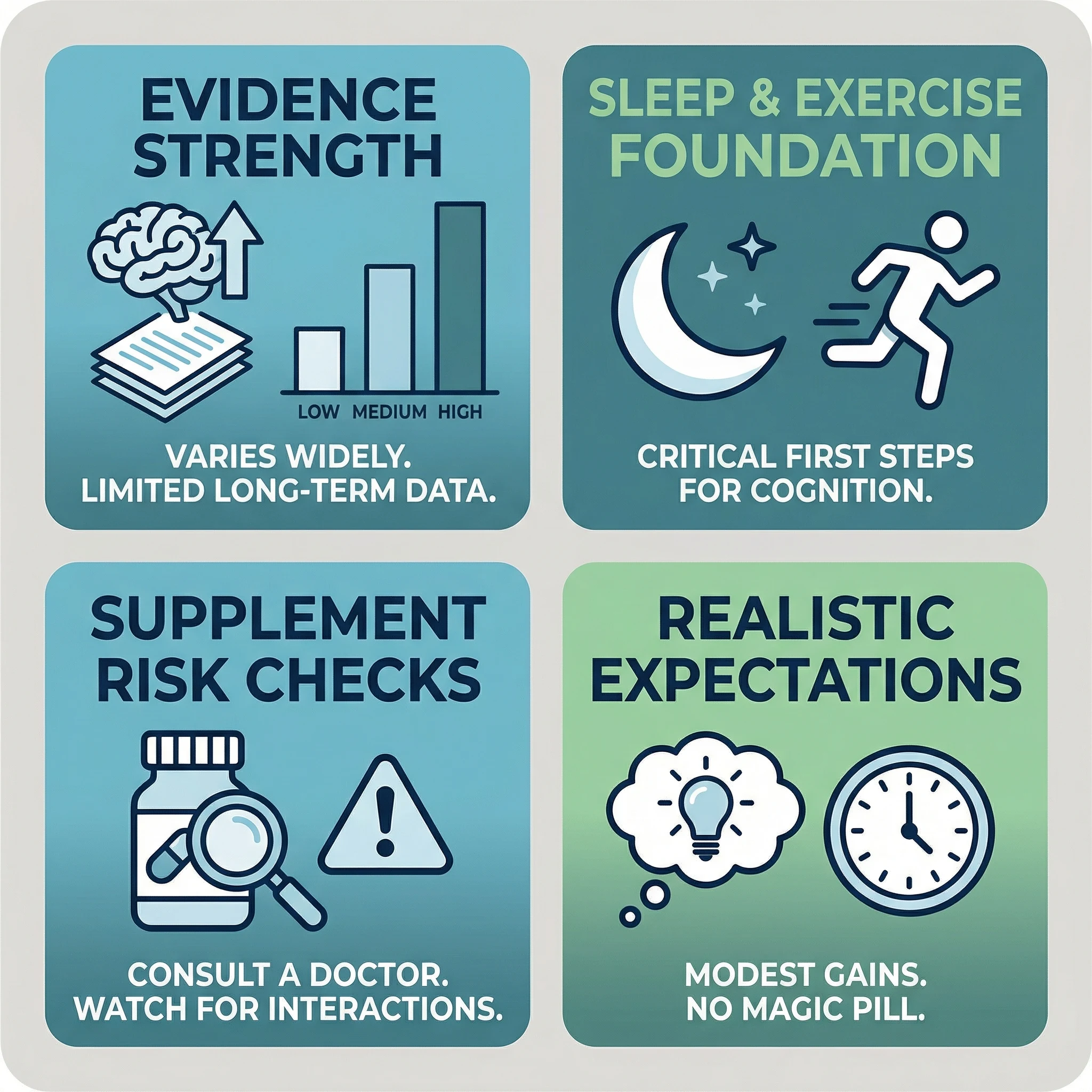
Quick take: The strongest "nootropic" effects for most healthy adults still come from sleep consistency, exercise, and focused work structure. Supplements may offer small gains in specific domains, but expectations should stay modest.
Can nootropics really improve focus in healthy adults?
Yes, some can improve specific cognitive tasks in some people, but the typical effect size is smaller and more context-dependent than marketing suggests. A useful way to think about nootropics is not "smart pill" versus "no effect." A better model is: which cognitive domain, in which population, under which conditions, at what dose, and with what tradeoffs?
For example, the evidence for prescription wakefulness agents and stimulants differs from evidence for non-prescription compounds such as caffeine, L-theanine, Bacopa monnieri, or creatine. Even within one compound, results vary by baseline sleep quality, age, nutritional status, clinical condition, and test design.
In healthy non-sleep-deprived adults, modafinil has shown improvements in some measures of executive function and attention in a systematic review (Battleday and Brem, European Neuropsychopharmacology, 2015). That does not mean everyone should use modafinil for productivity. It is a prescription drug with contraindications and adverse-event risk, not a general wellness supplement.
For legal supplements, effects are often subtler. A systematic review and meta-analysis on tea constituents found that caffeine and L-theanine together may improve aspects of attention and alertness in the short term (Camfield et al., Nutrition Reviews, 2014). The key phrase is "may improve aspects" not "transforms cognition."
If you are coming from broad marketing claims, this is the first reset: nootropics are best understood as targeted nudges, not cognitive overhauls.
A 2024 meta-analysis found memory gains with creatine, but not every domain improved
Creatine is one of the better examples of how nuanced nootropic evidence works. A 2024 systematic review and meta-analysis of randomized trials reported improvements in memory and some speed-related cognitive outcomes, while showing no significant improvement in overall cognition or executive function across pooled studies (Xu et al., Frontiers in Nutrition, 2024).
That pattern matters. It shows that "helps memory" and "improves cognition" are not interchangeable claims. A compound can help one domain and show little effect in another. In practice, that means your goal should be specific before you test anything. If your problem is sustained attention collapse at 3 PM, a supplement with weak evidence for attention but better evidence for memory may not solve your core issue.
| Compound | What higher-quality evidence suggests | Practical interpretation |
|---|---|---|
| Caffeine + L-theanine | Acute improvements in some attention and alertness outcomes in pooled short-term studies (Nutr Rev, 2014) | Useful for short work blocks if dose and timing are controlled |
| Creatine monohydrate | Meta-analysis suggests memory benefit; mixed effects across other domains (Front Nutr, 2024) | May support select cognitive tasks, especially when baseline energy demand is high |
| Bacopa monnieri | Earlier meta-analytic signal for attention and processing speed, but newer trials remain mixed (J Ethnopharmacol, 2014; Nutrients, 2025) | Potential but uncertain; response may vary and GI side effects are common |
| Omega-3 supplements | No broad cognitive benefit in many healthy-population analyses; possible benefit in low omega-3 status subgroups (Nutr Rev, 2015) | Better framed as nutrition correction than universal nootropic |
For readers who want broader foundational context before stacking products, our earlier primer on beginner nootropics and brain upgrades can help frame terminology and expectations.
The first mistake most people make is treating supplements like a substitute for sleep
If you only remember one section from this guide, make it this one. Sleep disruption can erase or blunt most productivity gains you expect from a nootropic. A 2024 meta-analysis found one night of sleep restriction significantly increased sleepiness and impaired sustained attention (Impact of one night of sleep restriction, 2024). Newer synthesis work on sleep variability and cognition also points in the same direction: inconsistent sleep patterns correlate with poorer cognitive performance.
People often interpret nootropics as "more output with less recovery." Biology usually does not cooperate. If you are under-recovered, stimulatory compounds can make you feel temporarily more alert while still leaving planning quality, emotional control, or error rates unimproved. Subjectively, you feel switched on. Objectively, quality may drift.
This is why high performers often improve more from sleep regularity than from supplement changes. If your wake time swings by 2 to 3 hours across the week, fix that first. If your caffeine timing spills into late afternoon, fix that second. If your evening light exposure and doom-scrolling are delaying sleep onset, fix that third. Then test supplements.
You can pair this guide with our practical article on improving sleep habits because sleep architecture and focus reliability are tightly linked in everyday work.
"Stacking" feels advanced, but basics still drive most performance gains

The supplement world rewards complexity. Long ingredient labels look scientific, and "synergy" language sounds sophisticated. But complexity is not the same as efficacy. In most cases, the reliable cognitive framework is still:
- Sleep consistency and total sleep opportunity.
- Movement and cardiorespiratory fitness.
- Stable glycemic and hydration patterns across the workday.
- Task structure that reduces context switching and interruption overhead.
- Then, and only then, targeted supplementation.
Exercise evidence is now broad and substantial. A 2025 umbrella review and meta-meta-analysis across many RCT-based reviews found exercise improved general cognition, memory, and executive function across populations (BJSM, 2025). You do not need elite training volumes for benefit. Moderate consistency outperforms occasional extremes.
Nutritionally, a food-first approach also reduces your risk of overfocusing on one expensive capsule while ignoring dietary gaps that directly affect cognition. If your daily pattern lacks protein at breakfast, omega-3 sources, iron-rich foods, or consistent hydration, nootropic outcomes will likely disappoint. Our guide to foods for thought and natural brain-supportive nutrition is useful here.
How to judge a nootropic claim before you spend money
A claim can look persuasive even when the evidence base is weak. Use this simple filter:
- Is the claim based on randomized human data, not only animal or in vitro data?
- Does the trial population match you (healthy adults, older adults, ADHD, sleep-deprived workers, etc.)?
- Was the outcome meaningful (real task performance) or mostly subjective mood scoring?
- Is the effect size clinically relevant or statistically significant but tiny?
- Are there replication studies from independent groups?
Take Bacopa as an example. Older meta-analytic work suggested improvements in attention speed and reaction-time outcomes (Kongkeaw et al., Journal of Ethnopharmacology, 2014). A newer 12-week RCT in healthy adults reported no between-group differences on primary cognitive outcomes, though some stress and fatigue-related measures improved (Nutrients, 2025). That is not "Bacopa works" or "Bacopa is useless." It is a mixed signal that requires careful expectation-setting.
Omega-3 claims are similar. A 2015 systematic review found little broad cognitive benefit in general populations, with possible improvement in subgroups with low baseline omega-3 status (Yurko-Mauro et al., Nutrition Reviews, 2015). This supports targeted use, not universal nootropic promises.
When in doubt, downgrade certainty and avoid all-in spending decisions.
Myth vs fact: what nootropics can and cannot do
| Myth | Fact | What to do instead |
|---|---|---|
| Nootropics make you smarter regardless of habits. | Most compounds show modest, context-dependent effects at best. | Fix sleep, workload structure, and recovery before supplement trials. |
| If something is sold as a supplement, it is pre-approved for safety. | In the U.S., supplements are generally not FDA-approved before market entry (FDA, 2025 consumer guidance). | Use third-party testing and clinician review for higher-risk cases. |
| Prescription stimulants are the best productivity tool for anyone. | These are medical treatments with risk profiles and should be used only with diagnosis and supervision. | If ADHD is suspected, seek formal assessment and guideline-based care. |
| More ingredients means better cognitive results. | Complex stacks often increase confounding and side-effect risk. | Use single-variable trials and track outcomes objectively. |
| If you feel more alert, your performance is definitely better. | Perceived alertness and actual task quality can diverge. | Track error rates, completion time, and retention, not just energy. |
For ADHD specifically, treatment decisions should follow professional guidance rather than internet stack culture. NICE guidance recommends medication for adults when symptoms cause significant impairment and after full clinical assessment, with structured non-pharmacologic support as appropriate (NICE NG87 recommendations).
What does a low-risk 30-day trial framework look like?

If you decide to test a nootropic, run it like a small experiment, not a lifestyle identity. The goal is decision quality, not supplement collection.
| Phase | What to do | Why it matters |
|---|---|---|
| Days 1-7 baseline | No new supplement. Track sleep, caffeine timing, task output, and errors. | Creates your personal control condition. |
| Days 8-21 single intervention | Add one compound only, at conservative dose, with fixed timing. | Reduces confounding and improves interpretability. |
| Days 22-28 hold or washout | Pause or continue while keeping all other variables stable. | Helps identify whether effects persist or fade. |
| Days 29-30 decision | Review objective metrics and side effects before continuing. | Prevents automatic long-term use without benefit. |
Use objective metrics that match your goal:
- Deep-work minutes completed without interruption.
- Error rate in repetitive or analytical tasks.
- Next-day recall of prior-day learning.
- Perceived anxiety, sleep latency, and sleep quality.
If adverse effects appear, stop and reassess. Common problems include GI discomfort, headache, jitteriness, elevated anxiety, and sleep disruption. If you are taking prescription medications, have cardiovascular risk factors, or have liver/kidney conditions, discuss trials with a licensed clinician first.
When nootropics can backfire: side effects, interactions, and regulation gaps

The nootropic conversation is often framed as benefit-only. Real-world use is risk plus benefit, and risk is often underdiscussed.
First, regulation. Under U.S. law, the FDA generally does not pre-approve dietary supplements for safety and effectiveness before market entry (FDA consumer information). Post-market enforcement exists, but that is not the same as pre-market approval. This is why product quality, label fidelity, and contamination risk remain critical concerns.
Second, ingredient status. Some compounds marketed in nootropic circles sit in legal or regulatory gray zones, and FDA warning actions have included products sold in the nootropic category with problematic claims or ingredient status concerns (for example, agency actions involving nootropic-marketed products and ingredients over recent years). Assume uncertainty until verified.
Third, interactions. Stimulatory combinations can amplify insomnia and anxiety. Blood-pressure effects, heart-rate shifts, and medication interactions are not theoretical for sensitive users. Even compounds viewed as "gentle" can be problematic in polypharmacy contexts.
Fourth, indication creep. Using prescription agents meant for diagnosed conditions as general productivity enhancers can bypass needed screening and monitoring. If you suspect underlying ADHD, depression, sleep disorder, or anxiety disorder, direct diagnosis and targeted treatment usually outperform improvised self-experimentation.
If stress is a key part of your attention breakdown, non-pharmacologic regulation can be a high-yield starting point. Our article on breathing techniques for stress relief offers structured methods you can test alongside workload changes.
Can food-first brain support outperform expensive stacks over time?
In many cases, yes. Food-first approaches win on adherence, lower risk, broader physiologic benefit, and lower long-term cost. If your baseline pattern is weak, the return on improving meals often exceeds the return on adding another capsule.
A practical brain-supportive plate pattern usually includes:
- Protein at each main meal.
- Omega-3-rich seafood or equivalent planning for low-intake individuals.
- High-fiber carbohydrates to reduce glucose volatility.
- Hydration and electrolytes matched to activity and climate.
- Predictable meal timing during high cognitive demand periods.
This does not mean supplements are never useful. It means they should be built on top of a stable physiological base. For memory-specific habits, our guide on improving memory performance can complement the framework here.
Another reason food-first matters: lifestyle interventions compound. Exercise, sleep, and nutrition reinforce each other. Better sleep improves training quality. Better training improves sleep pressure and mood regulation. Better nutrition stabilizes daytime energy and recovery. That positive loop can deliver larger cumulative cognitive gains than cycling through trendy stacks every month.
Frequently asked questions about nootropics and mental performance
Are nootropics safe for daily use?
Safety depends on the specific compound, dose, duration, your health status, and medication profile. Some compounds are generally well tolerated at studied doses, while others carry interaction risks, cardiovascular concerns, or regulatory uncertainty. Daily use should never be automatic.
Do nootropics treat ADHD?
No supplement should be treated as a substitute for evidence-based ADHD care. If ADHD is suspected, seek formal assessment and clinician-guided treatment. Prescription medication decisions should follow medical guidelines and individual risk assessment, not self-directed internet protocols.
Should I use a multi-ingredient stack or a single compound?
Single-compound trials are usually better first. They reduce confounding, make side effects easier to identify, and improve decision quality. Multi-ingredient stacks may feel efficient but are harder to evaluate and can increase adverse-event risk.
How long should I trial a nootropic before deciding?
It depends on the ingredient. Acute compounds can often be assessed over days, while some botanicals in trials are evaluated over 8 to 12 weeks. Regardless of timeline, define objective metrics in advance and stop if benefits are absent or side effects are meaningful.
What is the fastest way to improve cognitive performance without supplements?
Normalize sleep timing, protect 60- to 90-minute deep-work blocks, control caffeine timing, train regularly, and reduce constant task switching. For many healthy adults, that combination outperforms supplement-first strategies.
The mental edge usually comes from systems, not shortcuts
Nootropics can be part of a cognitive strategy, but they are rarely the foundation. The strongest long-term approach is a layered system: stable sleep, predictable training, nutrient-dense meals, stress regulation, focused workflow design, and then cautious, evidence-aware supplementation where appropriate.
Use nootropics as optional tools, not identity. Define the problem precisely, test conservatively, measure objectively, and keep claims proportional to evidence. That is how you protect both performance and health while still staying open to interventions that may genuinely help.
If you choose one next step this week, make it a baseline week with no new products and full tracking of sleep, output, and error rate. Most people learn more from that week than from another impulse purchase.