What Is Nicotinamide Riboside And How Does It Work
What Is Nicotinamide Riboside and How Does It Work? An Evidence-Based Ultimate Guide

Reviewed by Dr. Maya Hernandez, MD, MPH (Preventive Medicine)
Nicotinamide riboside, often shortened to NR, is one of the most discussed healthy-aging supplements in the NAD+ category. If you have seen claims that NR "recharges mitochondria," "turns back the clock," or "works like a cellular battery," you are not alone. The interest is understandable: NAD+ is central to energy metabolism, DNA repair signaling, and stress-response pathways, and NAD+ levels are associated with aging biology.
The difficult part is separating plausible biology from real-world outcomes. In lab models, boosting NAD+ can improve several aging-related pathways. In humans, the picture is more nuanced. Multiple trials show oral NR reliably increases NAD+ or related metabolites in blood. The bigger question is whether that biochemical rise consistently translates into better blood sugar control, stronger muscles, sharper cognition, or longer healthspan. So far, evidence suggests the answer depends on who is taking it, why, and for how long.
This guide explains what NR is, how it differs from other vitamin B3 forms, what the best human studies show up to 2026, what safety signals to watch, and how to make a practical decision with your clinician. If you are also building a broader healthy-aging strategy, these related guides can help with the bigger plan: best anti-aging and anti-wrinkle remedies, physical exercise and brain health, omega-3 benefits and supplement basics, nootropics and mental edge claims, and probiotic food and supplement context.
TL;DR: NR is a legitimate NAD+ precursor with consistent biomarker effects in humans, but clinical benefits are selective and usually modest. It is promising, not magical.
If NAD+ declines with age, can NR realistically raise it?
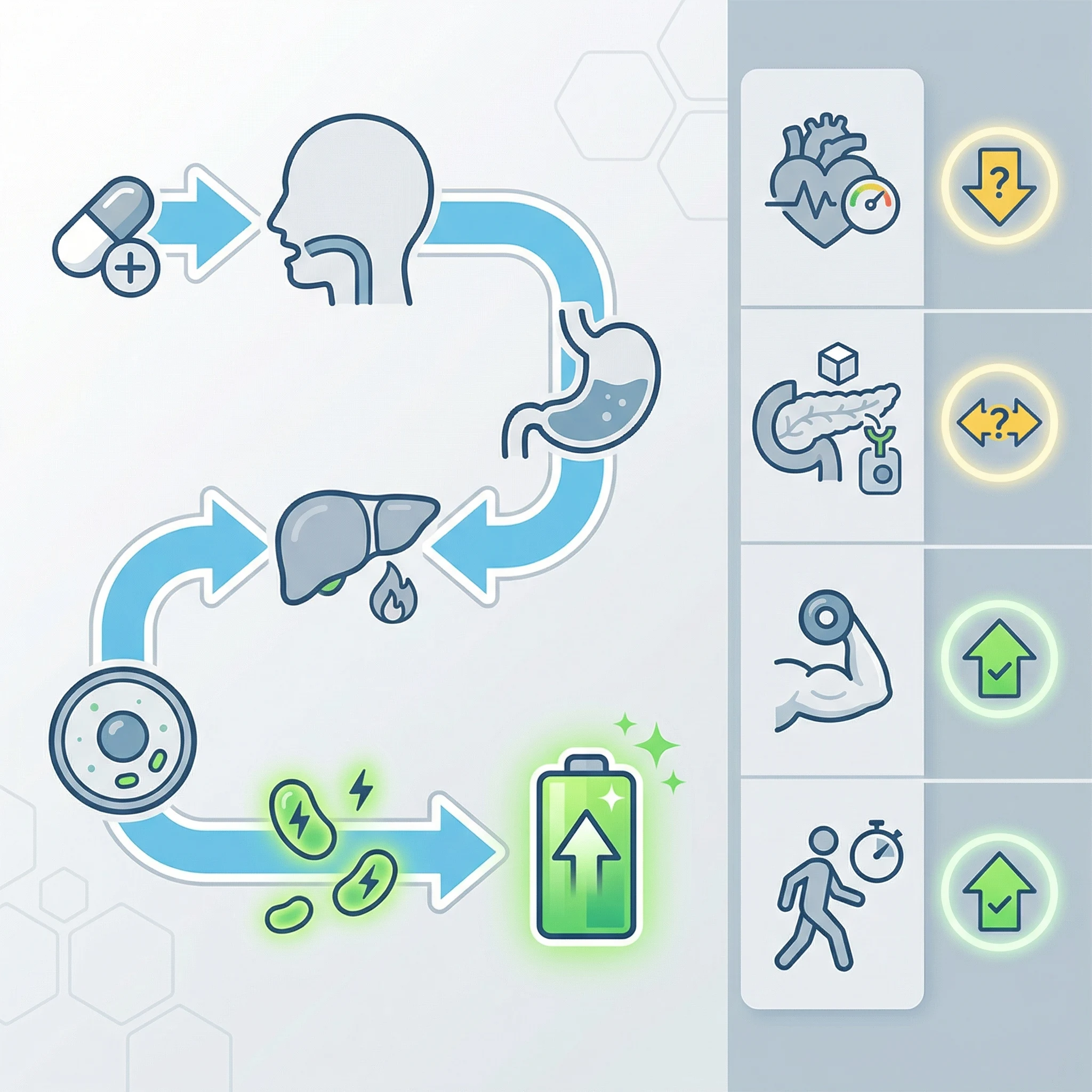
Yes. The strongest and most reproducible finding in NR research is that supplementation can raise NAD+ related metabolites in humans. That does not guarantee broad clinical benefit, but it is an important mechanistic step. Early human pharmacokinetic work established oral bioavailability, and later controlled trials in middle-aged and older adults confirmed sustained increases in NAD+-associated metabolites after daily dosing.
Mechanistically, NR is a vitamin B3 form that enters salvage pathways used to produce NAD+. NAD+ supports redox reactions, mitochondrial function, and activity of enzymes such as sirtuins and PARPs. From a biology perspective, the argument for NR is coherent: if NAD+ availability falls in some tissues with age or stress, restoring substrate availability could help specific systems perform better.
However, biology coherence is only step one. Clinical medicine requires outcomes. A supplement can improve a biomarker while leaving major endpoints unchanged. That is why NR should be evaluated by both pathway plausibility and endpoint data in humans.
| Question | What evidence says today | Confidence level | Practical takeaway |
|---|---|---|---|
| Does NR raise NAD+-related metabolites? | Yes, repeatedly shown in human studies | Moderate to high | Biochemical response is the most reliable effect |
| Does NR improve every aging outcome? | No, outcomes are mixed by population and endpoint | Moderate | Avoid all-purpose anti-aging expectations |
| Is NR equivalent to disease treatment? | No, current evidence does not support treatment replacement | High | Use only as an adjunct to standard care when appropriate |

What do the best human trials actually show in 2026?
The best way to judge NR is to line up the actual controlled trials and ask what changed, in whom, and over what duration. This avoids cherry-picking. Several well-cited studies show NR improves NAD+ biology. Clinical outcomes vary from neutral to potentially meaningful depending on baseline risk and study design.
In 2018, a randomized trial in healthy middle-aged and older adults reported that chronic NR supplementation was generally well tolerated and increased NAD+-related metabolites. A 2020 trial in adults with obesity found NR increased NAD+ metabolites but did not significantly improve insulin sensitivity over the intervention period. In 2022, a trial in older adults showed blood NAD+ and related signals increased, but body composition and skeletal muscle outcomes were not substantially changed.
More recently, a 2024 Nature Communications study in people with peripheral artery disease (PAD) reported improved walking endurance metrics with NR, suggesting that higher-risk clinical populations may show more functional benefit than low-risk healthy cohorts. A 2025 proof-of-concept study in long COVID also reported favorable shifts in fatigue and functional outcomes, but this remains early-stage evidence requiring replication.
| Study and population | Main biomarker finding | Main clinical finding | Interpretation |
|---|---|---|---|
| Healthy middle-aged/older adults (randomized trial, 2018) | NAD+-related metabolites increased | Generally well tolerated; broad functional effects limited | Good evidence for pathway engagement |
| Adults with obesity (randomized trial, 2020) | NAD+ metabolome increased | No significant insulin sensitivity improvement | Biochemistry improved without strong metabolic endpoint change |
| Older adults (randomized trial, 2022) | Blood NAD+ rose | No major body composition or muscle-function gains | Not a stand-alone physical performance solution |
| Peripheral artery disease (randomized trial, 2024) | NAD+ pathway support observed | Walking endurance improvements reported | Potentially stronger effect in higher-risk groups |
| Long COVID fatigue cohort (proof-of-concept, 2025) | Compatible with NAD-targeting rationale | Fatigue and function signals improved | Promising but preliminary and condition-specific |
This pattern is common in nutrition and supplementation science: stronger biomarker consistency than endpoint consistency. That does not make NR useless. It means NR should be treated as a targeted tool rather than a universal fix.

Why do results look modest in healthy people but sometimes better in higher-risk groups?
A practical reason is baseline ceiling effects. If a person is metabolically healthy, physically active, and already sleeping well, there may be less room for measurable improvement over short study windows. By contrast, populations with PAD, chronic fatigue, or higher inflammatory/metabolic burden may have more room for detectable functional gains when NAD-targeted pathways are supported.
Another factor is endpoint selection. If a trial asks whether NR changes fasting glucose in already near-normal participants, the study may return "no effect" even if mitochondrial or vascular biology shifts in ways not captured by that endpoint. This is why studies that include functional performance outcomes, such as walking distance in PAD, can reveal benefits that standard fasting markers miss.
Duration matters too. Many NR studies are relatively short by aging-medicine standards. Changes in aging trajectories are slower than changes in blood biomarkers. A 6-to-12-week increase in NAD+ does not automatically produce dramatic body composition or performance changes, especially if behavior patterns remain unchanged.
For this reason, many clinicians frame NR as a potential adjunct inside a broader plan rather than as a primary intervention. If sleep, movement, diet quality, blood pressure control, or medication adherence are unstable, fixing those usually provides larger returns than adding an NAD+ precursor alone.
How does NR compare with niacinamide, niacin, and NMN?
NR belongs to the vitamin B3 family. The NIH niacin fact sheet lists niacin, niacinamide, NR, and NMN as related compounds in the broader nicotinamide adenine dinucleotide context. But these forms are not interchangeable in how people tolerate them or in the strength of evidence for specific outcomes.
Niacin (nicotinic acid) has a long clinical history, including known lipid effects at pharmacologic doses, but flushing can limit tolerability. Niacinamide is widely used and often better tolerated than niacin for flushing-related symptoms. NR is mainly marketed for NAD+ and healthy-aging pathways. NMN is another NAD+ precursor with rapidly growing but still evolving human evidence. In practice, the right choice is not about internet popularity; it is about indication, tolerability, medication context, and quality control.
| Compound | Primary positioning | Typical strength | Main caution |
|---|---|---|---|
| Niacin (nicotinic acid) | Traditional B3 therapy and lipid-context use | Long clinical history | Flushing and dose-related adverse effects |
| Niacinamide (nicotinamide) | B3 repletion and dermatologic/metabolic interest | Broad familiarity and tolerability | High-dose use still needs supervision |
| Nicotinamide riboside (NR) | NAD+ support and healthy-aging pathways | Consistent biomarker response in humans | Clinical endpoint benefits are selective |
| Nicotinamide mononucleotide (NMN) | Alternative NAD+ precursor | Emerging human evidence | Long-term comparative evidence still developing |
Myth vs fact: what NR can and cannot do
NR conversations online are often distorted by absolutist language. Either NR is framed as a longevity breakthrough that everyone needs, or dismissed as complete hype. Both extremes are inaccurate. The evidence sits in the middle.
| Myth | Fact | Evidence direction |
|---|---|---|
| "NR reverses aging in everyone." | NR engages NAD+ biology, but broad anti-aging reversal in humans is unproven. | Contradicted by mixed clinical endpoint data |
| "If NAD+ rises, every health marker must improve." | Biomarkers and functional endpoints do not always move together. | Supported by several randomized human trials |
| "NR is useless because one study had neutral outcomes." | Neutral findings in one endpoint or population do not invalidate pathway effects everywhere. | Contradicted by positive and neutral results across different cohorts |
| "Supplements can replace sleep, movement, and medical care." | Foundational health behaviors and standard care remain primary. | High confidence from preventive medicine evidence |
| "More dose always means better outcomes." | Higher doses can increase cost and complexity without guaranteed extra benefit. | Consistent with dose-response uncertainty in current trials |
What dose range appears in research, and how should monitoring work?
Trial doses vary, and product labels differ by brand. Many studies use daily amounts in the few-hundred-milligram range, while some protocols test higher doses. A practical rule is to avoid jumping straight to the maximum on day one. Start with a conservative dose, evaluate tolerance, and review changes with a clinician if you have chronic conditions, take prescription medications, or are trying to improve a specific endpoint.
Most healthy adults in NR trials tolerated supplementation reasonably well, but short-term tolerability is not the same as guaranteed long-term safety across all populations. Evidence beyond trial windows is still growing. Any supplement used for months should be treated as part of a monitored plan, not a background habit that never gets reassessed.
| Phase | Goal | What to track | Decision point |
|---|---|---|---|
| Weeks 1-2 | Tolerance check | GI symptoms, sleep disruption, headaches, adherence | Continue only if tolerability is acceptable |
| Weeks 3-8 | Consistency and context | Energy trends, activity levels, blood pressure context, routine quality | Avoid attribution errors from unrelated routine changes |
| Weeks 8-12 | Outcome review | Target endpoint chosen before starting | Stop if no clear objective benefit |
| After 12 weeks | Long-term decision | Cost-benefit, safety, clinical relevance | Continue only with a clear reason |
This structure matters because supplement users often evaluate based on vague feelings alone. A pre-defined goal and timeline prevents indefinite use without evidence of value.

Who should pause and ask a clinician before starting NR?
Most supplementation decisions are low risk for healthy adults, but some situations need extra caution. If you are pregnant, breastfeeding, on cancer treatment, managing significant liver or kidney disease, taking multiple chronic medications, or under active specialist care, discuss NR before self-starting. Clinical trial populations usually exclude higher-complexity patients, so direct evidence may be limited in these groups.
If your goal is to treat a diagnosed disease, prioritize evidence-based medical therapy first. NR should not delay treatment initiation, medication optimization, or specialist follow-up. In practice, the best use case is usually adjunctive and clearly bounded: support a specific wellness goal while standard care remains intact.
Quality control also matters. Choose products with third-party testing and transparent labeling. A high-quality supplement with clear lot data is better than a heavily marketed product with poor traceability.
What if you want better aging outcomes than NR alone can deliver?
The highest-return strategy is still stacking fundamentals. Exercise remains one of the most reliable interventions for metabolic and cognitive resilience; this is why movement-first planning generally outperforms supplement-first planning in healthy adults. If you are comparing options, spending effort on a structured training and sleep routine often produces larger gains than adding multiple new compounds.
Diet quality also changes how useful any supplement can be. Protein adequacy, fiber intake, and cardiometabolic food patterns shape recovery and energy far more than any single capsule. NR can fit into a broader plan, but it does not compensate for persistent under-sleeping, inactivity, or poor cardiometabolic control.
A practical lens is this: if the basics are weak, fix basics first. If the basics are strong and your clinician agrees your goal is reasonable, a time-limited NR trial can be defensible.
Frequently Asked Questions
Is nicotinamide riboside the same thing as niacin?
No. NR and niacin are both in the broader vitamin B3 family but have different pharmacology and tolerability profiles. NR is primarily used for NAD+ pathway support, while niacin has different historical clinical use patterns.
How quickly does NR increase NAD+ markers?
Human studies suggest NAD+-related metabolites can rise within weeks. But that biochemical shift does not guarantee immediate changes in body composition, blood sugar, cognition, or athletic performance.
Does NR help with weight loss?
Current human evidence does not support NR as a primary weight-loss therapy. It should not replace nutrition, exercise, sleep, and clinician-guided metabolic care.
Can I combine NR with other longevity supplements?
Possibly, but more is not always better. Combining multiple products increases complexity and makes it harder to identify what helps or causes side effects. If combining, do it with a clinician-defined objective and monitoring plan.
Should everyone over 40 take NR?
No universal recommendation exists. A better approach is individualized: assess goals, baseline health, budget, medication context, and whether you can define a measurable outcome before starting.
The bottom line: NR is promising biology with selective clinical upside
Nicotinamide riboside is not a scam and not a miracle. The evidence supports a real mechanistic effect on NAD+-related biology in humans. Clinical outcomes are mixed and context-dependent, which is exactly what serious readers should expect in a developing field. If you want to try NR, do it as a structured experiment with clear goals, not as an open-ended hope strategy.
The most defensible plan in 2026 is straightforward: preserve evidence-based fundamentals, use supplements conservatively, and decide continuation based on objective benefit rather than marketing claims.
Sources
- Trammell SAJ et al. Nicotinamide riboside is uniquely and orally bioavailable in mice and humans (Nature Communications, 2016).
- Martens CR et al. Chronic nicotinamide riboside supplementation is well tolerated and elevates NAD+ in healthy middle-aged and older adults (Nature Communications, 2018).
- Remie CME et al. Nicotinamide riboside supplementation alters body composition and skeletal muscle acetylcarnitine concentrations in obese humans (Clinical Nutrition, 2020).
- Dollerup OL et al. A randomized placebo-controlled clinical trial of nicotinamide riboside in older adults (Aging Cell, 2022).
- Nicotinamide riboside treatment significantly improves functional walking in people with peripheral artery disease (Nature Communications, 2024).
- Lindqvist M et al. Efficacy and safety of nicotinamide riboside in long COVID (EClinicalMedicine, 2025).
- Radenkovic D et al. Evaluating nicotinamide riboside as an anti-aging intervention in humans (Experimental Gerontology, 2024).
- NIH Office of Dietary Supplements. Niacin fact sheet for health professionals.